
Talk to a bath specialistFree · No obligation
(833) 334-4470
Carmel — an affluent north-Indianapolis suburb of roughly 92,000 people and the self-described Roundabout Capital of the United States, with more than 140 roundabouts including the first roundabout ever built in America in the late 1990s — runs one of the highest-expectation housing markets in the Midwest. The building wave of the 1990s and 2000s filled subdivisions across the city with large family homes and sprawling master suites built around the era's centrepiece: the oversized garden tub. In the Village of West Clay and the executive subdivisions north of 146th Street, those tubs are now the most removed fixture in the city — homeowners kept the footprint and never kept the bath. The typical Carmel project is the master suite rebalanced around a walk-in shower: the garden tub out, a large low-step shower with a bench and a proper fixture in its place, the rest of the suite untouched. Alongside it runs a second market: aging-in-place upgrades in long-held subdivisions, where a bath that was luxurious in 1999 is a climbing hazard in the 2020s. And a third: pre-sale renovations, because in a market where buyers tour ten nearly identical master suites in a weekend, the dated one loses. Being Sauna connects Carmel homeowners with vetted local wet-area specialists: honest cost ranges published up front, a free in-home assessment that measures your bathroom instead of quoting a city average, and a written quote that never pressures you to sign today.
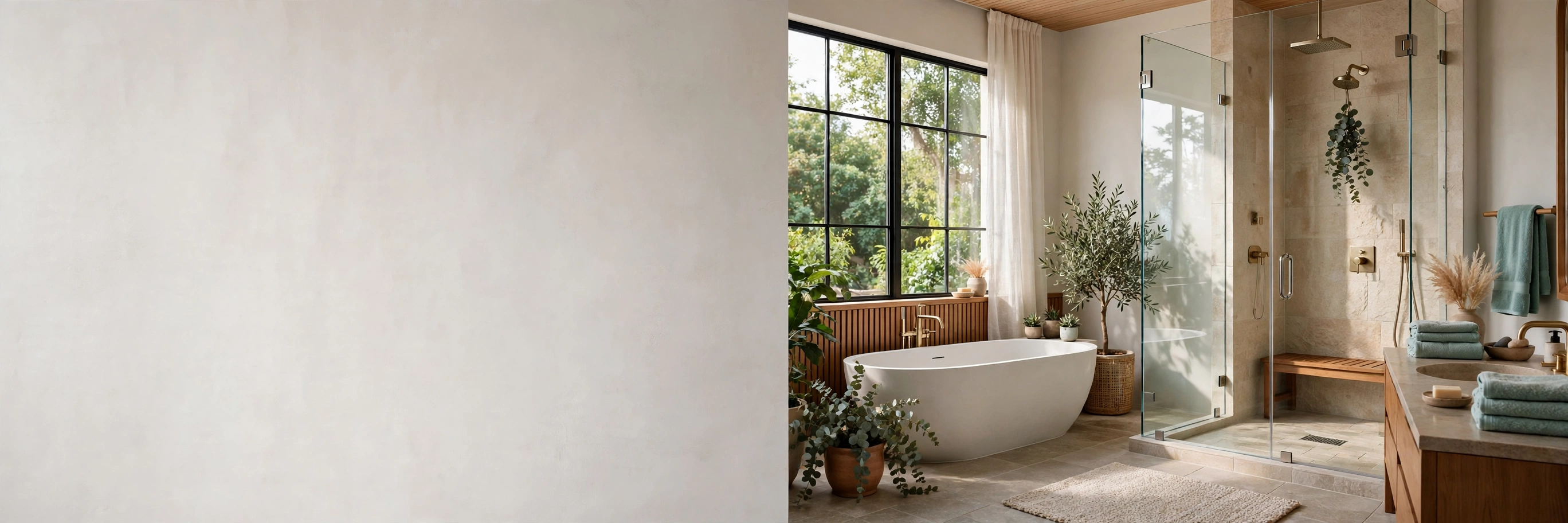
In short: Bathroom remodeling in Carmel, IN focuses on the wet area: tub-to-shower conversions ($8,500–$17,000), shower replacement ($7,500–$15,000), walk-in showers ($9,000–$18,000) and tub replacement ($6,500–$13,000), installed by vetted local specialists. Carmel's 1990s–2000s housing — master suites built around oversized garden tubs, fibreglass stall showers in the hall baths — plus Clay Township municipal water that scales fixtures over time make the free in-home assessment especially valuable: plumbing, valve, ventilation and subfloor conditions are checked before you sign anything. Call (833) 334-4470.
Six services, one specialty — the tub and shower. Each links to its full guide with costs and process; the ranges below are what Carmel homeowners actually budget against.
The city's signature swap — the oversized garden tub of the 1990s master suite out, a large low-step walk-in shower in the same footprint. In West Clay and the subdivisions north of 146th Street, this is the project that changes how the whole suite feels, in one to three days.
For the hall-bath fibreglass stalls that served the kids and now serve the guests — flexed, yellowed and tired after twenty-five years. Pan, valve and walls replaced together so the master-suite standard extends to the rest of the house.
Easy-entry showers with a bench, grab bars anchored to structure and controls reachable from a seat — built for aging in place in upscale subdivisions without looking clinical, the luxury and the safety designed together.
Some master suites keep a bath — and Carmel buyers expect a deep soaker when they do. A proper modern tub with fresh plumbing and surround, usually inside two days, replacing the shallow builder-grade original.
Bought a shower-only suite and then the family needed a bath for small children, or a pre-sale plan calls for a soaking tub to complete the master? Bring the tub back properly, plumbed and sealed for decades.
Whole-suite overhauls and pre-sale renewals across one of Indiana's strongest housing markets — one project, one written quote, wet area first and finishes to match the neighbourhood.
Carmel runs an upscale contractor market where showroom-grade finishes are common, so realistic local budgets often land in the middle to upper half of these ranges. The lower half is where the job is straightforward — a like-for-like swap in a bathroom replumbed within the last decade, where the room itself is the whole job. The upper half is where Carmel's own standards take over: larger shower footprints, premium tile and fixtures, or a master-suite layout that asks for real design work alongside the plumbing.
| Project | Planning range |
|---|---|
| Tub-to-shower conversion | $8,500 – $17,000 |
| Shower replacement | $7,500 – $15,000 |
| Walk-in shower | $9,000 – $18,000 |
| Bathtub replacement | $6,500 – $13,000 |
| Shower-to-tub conversion | $7,500 – $14,000 |
| Full bathroom remodel | $15,000 – $35,000+ |
Planning ranges based on published national installer pricing (2026), for budgeting guidance — not quotes. Two honest warnings. First: travelling one-day outfits work the US-31 and Keystone Parkway corridors with headline prices that shift mid-appointment — publishing the ranges on this page is exactly how we keep comparisons honest. Second: in a market where buyers compare finished master suites side by side, the quote you compare should cover the full wet-area job — pan, valve, walls, ventilation — not just the shower. The cheapest number usually skips the details that show up on a home inspection. Full methodology: the 2026 cost guide.
Carmel's defining statistic is not a price — it is a circle. The Roundabout Capital of the United States, with more than 140 roundabouts and the first roundabout ever built in America completed here in the late 1990s, says something about how this city plans: deliberately, early, and all the way through. A Hamilton County suburb of roughly 92,000 on the north side of Indianapolis, Carmel grew fast in the 1990s and 2000s on executive subdivisions, top-ranked schools, a curated downtown around the Arts & Design District, and the Monon Trail running through the middle of it. The bathroom consequence of that growth era is specific and citywide: master suites designed around the oversized garden or whirlpool tub, the fixture that sold the house in 1999 and now sits unused in 2026, holding the footprint the walk-in shower wants.
The Village of West Clay — a 600-plus-acre planned community with its own centre — and the subdivisions north of 146th Street hold the classic Carmel master bath: double vanity, separate water closet, and a tub deck the size of a small car. The hall baths got the era's builder-grade fixtures: fibreglass stall showers and tubs that now show twenty-five years of it — yellowed, flexed, valve cartridges worn stiff. Clay Township's municipal water arrives moderately hard; it is not a pipe threat, but it scales fixtures and dulls glass over the years, which is why aging valves deserve replacement while the walls are open and why solid-surface walls and coated glass earn their place on the spec sheet. None of that is exotic work — it is simply Carmel-appropriate work.
Carmel runs three bathroom markets at once, and the right project depends on which one you are in. Aging in place: empty-nesters who bought the subdivision home in 1999, love the neighbourhood and have no intention of moving, whose garden bath is now a climbing hazard — the low-step shower with a bench and grab bars, finished like a spa rather than a clinic. Pre-sale: Carmel's market punishes the dated master suite, so sellers convert the tub and refresh the hall bath before listing, because ten buyers comparing ten suites on a weekend notice exactly one dated bathroom. And everyday family use: the hall baths that raised two children and now serve teenagers and guests, where the fibreglass is simply done.
None of that is visible from a website quote form, which is why our assessment measures your bathroom rather than quoting from a city average. In Carmel, the average is the least reliable number there is — the right plan for a 1998 West Clay master suite and the right plan for a 2016 infill off the Monon share almost nothing except the phone number you call to start. A wet area rebuilt for Carmel's water, on Carmel's plumbing, at Carmel's finish expectations, is not a bigger job; it is simply a job measured first.
Our Carmel coverage centers on the 46032 and 46033 ZIPs across Hamilton County, with specialists travelling the US-31 and Keystone Parkway corridors daily — typical directions:
Coverage centers on Carmel and the 46032–46033 ZIP range across Hamilton County, with specialists travelling the US-31 and Keystone Parkway corridors into Boone County.
Planning ranges on every page — no "call for price", no appointment required before you can budget. In a market like Carmel's, where finish levels vary wildly from suite to suite, knowing the range first is what keeps a project honest.
The price you sign is the price you pay. Quotes are written, itemised and valid beyond the day of the visit — take your time deciding, compare them line by line if you like.
Installers are independent local contractors checked for licensing, insurance and wet-area specialisation before they take a single Being Sauna job in Hamilton County.
The biggest complaint in this industry is the same-day pressure close. Our specialists are instructed the opposite way: measure, explain, quote in writing, leave. The decision is yours, on your timetable.
Tell a specialist what's going on with your bathroom — two minutes, no obligation, no script-reading call centre.
A local specialist measures, checks the plumbing and subfloor, and leaves you an exact written quote that doesn't expire when they walk out.
Most wet-area projects finish in one to three days, the work area left clean and old materials hauled away.
Most wet-area projects in Carmel follow national planning ranges: tub-to-shower conversions $8,500–$17,000, shower replacements $7,500–$15,000, walk-in showers $9,000–$18,000, bathtub replacements $6,500–$13,000, shower-to-tub conversions $7,500–$14,000 and full bathroom remodels $15,000–$35,000+, installed. Carmel's contractor market is upscale without being overheated — showroom-grade finishes are common, so realistic local budgets usually land in the middle to upper half of the ranges. The upper half is where Carmel's standards take over: larger shower footprints, premium tile and fixtures, or a master-suite layout that asks for real design work. The lower half is where the job is straightforward — a like-for-like swap in a bathroom replumbed within the last decade, where the room itself is the whole job. Your exact price is confirmed in writing after a free in-home assessment.
The tub-to-shower conversion — and in Carmel it is the defining project. The Village of West Clay and the subdivisions north of 146th Street were built around the 1990s master suite: double vanity, separate water closet, and an oversized garden or whirlpool tub that was the selling point in 1999 and now sits unused, collecting dust and footprint. The standard move is the tub deck out, a large walk-in shower with a bench in the same space, in one to three days. The rest of the suite usually stays — which is exactly why the conversion dominates here: it rebalances the room without rebuilding it. The assessment checks the plumbing behind the tub deck and the 1990s valve bodies before quoting, so the new shower gets fresh supplies rather than sitting on twenty-five-year-old cartridges.
In Carmel, yes — because of how buyers shop here. Carmel buyers tour ten nearly identical 1990s master suites in a weekend, and the one that still reads 2002 loses — not on a headline discount, but on momentum: fewer second showings, quieter offers. The wet-area update — the garden tub converted to a walk-in shower, the hall bath refreshed — is the highest-visibility move per dollar before listing, and it photographs. Here is the honest version too: a bathroom does not add a dollar for every dollar spent, and it will not rescue a house that is mispriced or sitting on a busy road. But for a well-priced Carmel listing, a dated master suite is the detail buyers negotiate down, and removing that detail before the listing removes the leverage. If a sale is the plan, bring that timeline to the assessment — installs finish in days, not months, so you can time it for the listing photos.
Yes — in Carmel this is almost the whole brief. The typical aging-in-place client here is an empty-nester who bought the subdivision home in 1999, loves the neighbourhood and has no intention of moving, and refuses a bathroom that looks like a hospital. The answer is a genuinely low-step shower with a slip-resistant base, a built-in or fold-down bench, and grab bars anchored to structure — then finished like the suite around it: large-format tile, a rainfall or hand-shower fixture, glass to the ceiling if the layout allows. The safety lives in the engineering — entry height, bar placement, control reach from a seat — not in the appearance. Height and mobility set the dimensions, and the written quote covers exactly that work, nothing upsold beyond it.
Yes, modestly — Clay Township's municipal water arrives moderately hard, and over the years that shows on fixtures: scale on glass, stiffened valve cartridges, dulled finishes. It is not a pipe threat, but it is the reason aging valves deserve replacement while the walls are open rather than being reused behind a new shower surround. The assessment notes the water condition in your home and the specialist plans the install around it: solid-surface walls where the water is hardest on grout, coated glass, and pressure-balancing valves sized for the house. One habit helps more than any coating: a quick squeegee after showering. Foundation drainage and water quality treatment are outside our wet-area scope, but the fixtures in your new bathroom are specified for the water that actually runs through them.
How Being Sauna works (transparency note): Being Sauna is a free homeowner service that connects you with independent, vetted local bathroom remodeling contractors — we do not install bathrooms ourselves. Our cost figures are planning ranges drawn from published national installer pricing and reviewed for accuracy; see our cost guide methodology. This page was last reviewed in October 2026. Questions: beingsauna@gmail.com or (833) 334-4470.
Free in-home assessment in Carmel · No pressure · No obligation
Call (833) 334-4470