
Talk to a bath specialistFree · No obligation
(833) 334-4470
Greentown — about 5,901 people in the 46936 ZIP area, in Howard County — is a farm town turned commuter town on US-35 and State Road 22 between Kokomo and Marion, with Amboy, Russiaville, Swayzee, Converse, Gas City and Fairmount nearby. Greentown grew up as a farming community in the flat, fertile country of north-central Indiana, and its older core still reads that way: modest homes on town streets, built when the town was young, with the farmland never far away. Then the corridor changed the town. As Kokomo's factories and Marion's employers drew workers from across Howard County and Grant County, Greentown became the place many of those workers chose to live — close enough to the highway for a short commute, small enough to stay a town rather than a suburb. The 1960s, 70s, 80s and 90s filled the streets beyond the older core with ranch homes and two-storey family houses, built for commuters who wanted a yard, a garage and a bathroom that could handle a working family's mornings. The Eastern High School district anchors the town's family life, and the school campus is one of the first landmarks a visitor notices on the way through. The 46936 ZIP area reaches beyond the town limits, gathering commuter houses, older-core homes and farmhouses across the surrounding farmland. The older-core homes carry baths fitted when the house was built and reworked whenever a family grew; the ranch and two-storey commuter houses carry the tub-shower units of the post-war and late-century decades, ageing out faster than their owners expect; and the farmhouses carry the longest histories of all, with bathrooms added or moved across generations. Being Sauna connects Greentown homeowners with vetted local wet-area specialists: honest cost ranges published up front, a free in-home assessment that measures your bathroom instead of quoting a county average, and a written quote that never pressures you to sign today.
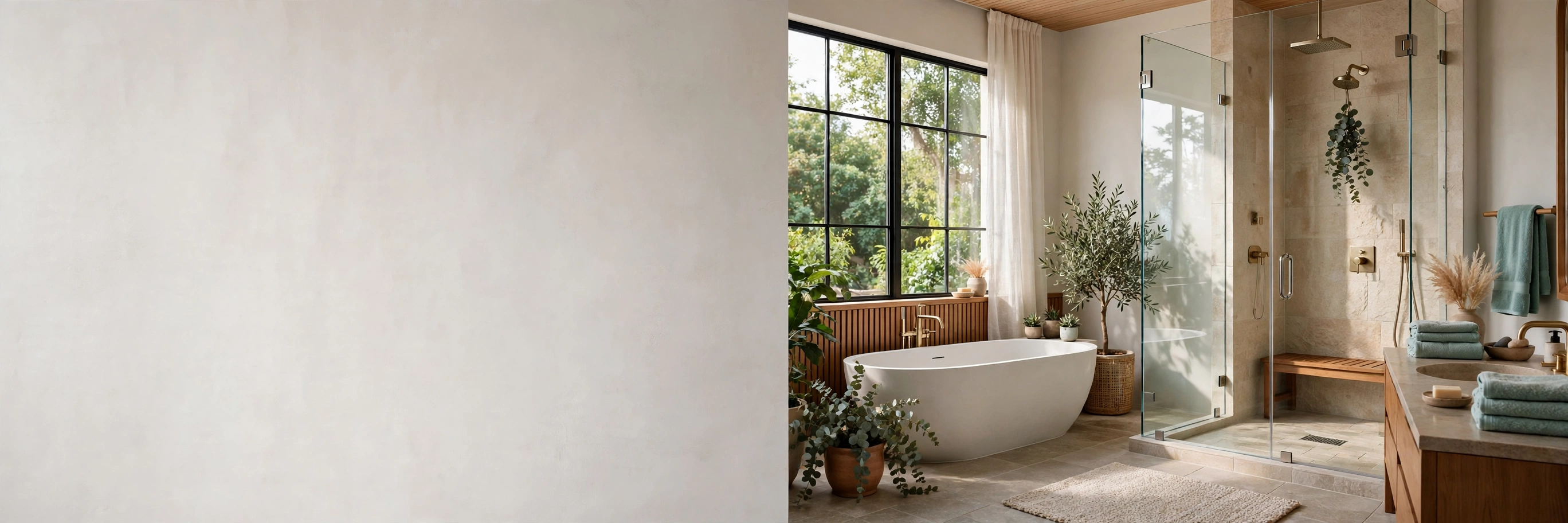
In short: Bathroom remodeling in Greentown, IN focuses on the wet area: tub-to-shower conversions ($8,500–$17,000), shower replacement ($7,500–$15,000), walk-in showers ($9,000–$18,000) and tub replacement ($6,500–$13,000), installed by vetted local specialists. Greentown housing — gas-boom-era homes in the older core, 1960s–90s ranch and two-storey commuter houses, and farmhouses on the surrounding roads — plus older plumbing, hard limestone-aquifer water and long-serving tubs makes the free in-home assessment especially valuable: pan, valve, drain, water pressure, subfloor and fixture conditions are checked before you sign anything. Call (833) 334-4470.
Six services, one speciality — the tub and shower. Each links to its full guide with costs and process; the ranges below are what Greentown homeowners actually budget against.
The most common Greentown project: the tall-rimmed tub in a 1970s ranch that asks for a high step every morning before the commute to Kokomo, or the worn tub in an older-core home that has served a working family for decades and no longer drains the way it should. Replace it with a low-entry shower in the same footprint, sealed walls and a new pan and valve, and the room starts working every day instead of being worked around. In a two-storey commuter house the same conversion fixes a different problem — a cramped upstairs tub-shower unit replaced by a shower sized for adults, with a drain set to fall cleanly and a valve chosen for hard limestone water.
For the tired showers in the ranch subdivisions and the worn units in the two-storey commuter houses — surrounds whose seams have gone soft under years of daily family use, valves worn by decades of showers, and drains tired after years of hard-water scale. Limestone-aquifer water adds its own wear, scaling valves and dulling glass long before the surround itself gives up. Pan, valve and walls replaced together so the wear stops at the source, not at the surface, and the subfloor beneath is checked for damp before the new work goes in.
Staying put in the ranch you raised a family in, or making an older-core home work for a parent who now needs a safer step — low-entry showers with a bench, properly anchored grab bars and controls you can reach seated, planned around the existing footprint rather than against it. In a Greentown ranch the blocking goes into real structure behind the wall, and the pan is set so the drain still falls cleanly even where the house has settled unevenly over fifty years. Blocking goes into real structure behind the tile, not into hope.
Families across Howard County still need real tubs for kids, and homeowners replacing a stained original tub want the same deep soak without the same wasted floor space. Deeper modern replacements with fresh plumbing and surround, usually inside two days, and sized for the Greentown bathroom rather than the catalogue. In a commuter house with a hard-working family bathroom, the subfloor around the tub is checked before the new tub goes in, so a heavy new tub never sits on framing that has already carried a leaking tub for years.
Bought a shower-only ranch home and then the family grew, or the grandkids started coming over from Kokomo and Marion and the bath needs to work for them too? Bring the bath back as a proper tub-shower combination, plumbed and sealed right for a house that will hold it for decades, with a surround that survives daily family use and hard limestone water.
Whole-room reworks for the older-core baths that have never been touched since they were built, and for the ranch baths whose tub and shower both need reworking — one project, one written quote, wet area first, and the home character respected throughout, from the older-core houses to the ranch subdivisions and the two-storey commuter homes beyond. Ventilation gets planned as part of the room here, not as an afterthought, because a hard-working family bathroom without good air movement will undo good tile work faster than anywhere else in the house.
Greentown runs on the Howard County contractor market — crews travelling the US-35 and State Road 22 corridor between Kokomo and Marion every week — so most jobs land in the middle of these ranges. The spread comes from the house, not the ZIP: a straightforward alcove tub swap in a ranch home is a simpler job than an older-core home where the drain sits in an awkward spot, a two-storey house where the upstairs bathroom needs its subfloor checked before a heavier tub goes in, or an older home whose supply lines and drain route both need renewal. The upper half of a range is a choice or a house condition, never a surprise, because it is priced in the written quote.
| Project | Planning range |
|---|---|
| Tub-to-shower conversion | $8,500 – $17,000 |
| Shower replacement | $7,500 – $15,000 |
| Walk-in shower | $9,000 – $18,000 |
| Bathtub replacement | $6,500 – $13,000 |
| Shower-to-tub conversion | $7,500 – $14,000 |
| Full bathroom remodel | $15,000 – $35,000+ |
Planning ranges based on published national installer pricing (2026), for budgeting guidance — not quotes. One piece of Greentown honesty: the quote you compare should cover the pan, the valve and the drain together — the cheapest number usually leaves a worn valve or a tired drain behind new walls, and the room below pays for it. Hard-water owners: mention the scale, the stiff valve and any falling shower pressure at the first call and the fixtures are chosen around them. Full methodology: the 2026 cost guide.
Greentown's story is a farm-town-turned-commuter-town story, told at Howard County scale. The town grew up as a farming community in the flat, fertile country of north-central Indiana, and its life stayed close to that founding for a long time: modest homes on town streets, the farmland all around, and the roads out to Kokomo, Marion and the smaller farm towns nearby carrying families to work, school and shopping. The older core still shows that first chapter — homes built when Greentown was a young farm town in Indiana's gas-boom years, lived in hard and updated piecemeal across the twentieth century. Then the corridor wrote the second chapter. US-35 and State Road 22 run through Greentown on the way between Kokomo, the Howard County seat, and Marion, the Grant County seat, and as those two cities drew workers from across the region, Greentown became the place many of them chose to live: close enough to the highway for a short commute, small enough to stay a town. The Eastern High School campus anchors that family life, and the school district is one of the reasons commuter families pick Greentown over a house closer to the factory gate or the office park.
Beyond the town limits, the corridor opens in both directions. Kokomo sits to the west along US-35 and State Road 22, the county seat and the employment centre for much of Howard County, with its auto-industry history and its own older neighbourhoods and commuter subdivisions. Marion sits to the east, a larger Grant County city with its own manufacturing and college presence. Between and around them sit the smaller towns that share Greentown's rhythm: Amboy to the north, Russiaville to the west toward Kokomo, Swayzee and Converse to the east toward Marion, Gas City to the southeast, and Fairmount further east in Grant County. The homes out that way live a similar rhythm to Greentown's own: ranch homes that serve a commuter household from before dawn, two-storey houses whose bathrooms take a hard daily workout from kids and visiting family, and farmhouses that sit at the end of long drives and longer drain runs. A Greentown bathroom, in other words, is rarely a quiet bathroom — it is a before-work bathroom, a school-morning bathroom, and a weekend-family bathroom all in one room.
Five Greentown conditions shape every wet-area project. First, the older-home plumbing: supply lines and drains laid decades ago, valves that have outlived several surrounds, and subfloors that have carried a tub's weight through more than one generation get checked before new work is sealed behind walls, because a beautiful shower over a failing drain is a short-lived shower. Second, the gas-boom-era addition: a bathroom added to the back of an older-core home can sit a long way from the main drain, with a long, shallow drain route and a subfloor that has settled unevenly, so the drain route, the drain fall and the subfloor around the tub are checked before the new work is fitted. Third, the hard water: much of Howard County draws on limestone aquifers, and mineral-rich water scales showerheads, clouds glass and wears valves faster than soft water does, so the valve and fixtures are chosen for hard water from the start, and a showerhead that can be cleaned or replaced without tools is often the right call. Fourth, the commuter-home layout: ranch and two-storey houses built for working families often fitted the bathroom tight, with the tub, toilet and basin crowded into a single small room, so the remodel has to earn its space — a low-entry shower in the same footprint, storage that does not steal floor space, and a layout that lets two people get ready at once without getting in each other's way. Fifth, the long-serving tub: a tub that has carried a family for forty or fifty years rarely fails alone — the surround seams, the valve and the subfloor around it usually wear together, so pan, valve and walls are replaced together rather than one at a time.
The corridor geography matters for scheduling too, in a practical way. Crews serving Greentown work the whole US-35 and State Road 22 route, and a Greentown job sits on a route that already runs through Kokomo, Russiaville, Marion, Swayzee and Converse in the same week. That keeps follow-up visits simple and keeps the written quote grounded in Howard County pricing rather than a price carried in from a distant city. It also means the crews know the housing: they have seen the older-core homes with their patchwork plumbing, the ranch baths with their compact layouts and hard-water scale, and the two-storey commuter houses with their upstairs bathrooms, and they plan for those conditions before the first wall comes down rather than discovering them halfway through the job.
That is why the assessment measures your bathroom instead of quoting a county average — in Greentown, the average is the least reliable number there is. The right plan for an older-core bath, the right plan for a ranch bath with hard-water scale, the right plan for a two-storey commuter bath with a tired upstairs tub, and the right plan for a full remodel share almost nothing except the phone number you call to start. Older-core owners: mention past additions and the older plumbing at the first call, and the specialist plans around them. Ranch owners: mention any slowing drain or springy floor near the tub. Hard-water owners: mention the scale and any falling shower pressure. A wet area rebuilt for the corridor, the farms and Howard County is not a bigger job; it is simply a job measured first.
Our Greentown coverage centres on Howard County and ZIP 46936, with specialists travelling between Greentown, Kokomo, Marion, Amboy and Russiaville weekly — typical directions:
Coverage centres on Greentown and the 46936 ZIP across Howard County, with specialists travelling toward Kokomo, Marion and Amboy weekly, and east to Swayzee and Converse.
We are the only bath service in this niche that publishes planning ranges on every page. No “call for price”, no games — you budget before anyone visits.
The price you sign is the price you pay. Quotes are written, itemised and valid beyond the day of the visit — take your time deciding.
Installers are independent local contractors checked for licensing, insurance and wet-area specialisation before they take a single Being Sauna job — including experience with older-home plumbing, gas-boom-era addition drain and subfloor checks, hard-water scale and valve wear from limestone-aquifer water, compact commuter-home layouts, long-serving tubs and subfloors, and Howard County ranch and two-storey houses.
The biggest complaint in this industry is the same-day pressure close. Our specialists are instructed the opposite way: measure, explain, quote in writing, leave.
Tell a specialist what's going on with your bathroom — two minutes, no obligation, no script-reading call centre. Mention the older-core home, the ranch or the two-storey commuter house, and any older-plumbing, drain, hard-water or subfloor history, so the right specialist is booked.
A local specialist measures, checks the plumbing, subfloor and ventilation, and leaves you an exact written quote that doesn't expire when they walk out.
Most wet-area projects finish in one to three days, the work area left clean and old materials hauled away.
Most wet-area projects in Greentown follow national planning ranges: tub-to-shower conversions $8,500-$17,000, shower replacements $7,500-$15,000, walk-in showers $9,000-$18,000, bathtub replacements $6,500-$13,000, shower-to-tub conversions $7,500-$14,000 and full bathroom remodels $15,000-$35,000+, installed. Greentown housing runs from gas-boom-era homes in the older town core to 1960s-90s ranch and two-storey homes in the commuter subdivisions, so most jobs land in the middle of the ranges. The upper half applies where the house demands it: an older-core home whose supply lines and drain route both need renewal, a ranch whose original valve and drain have both worn out, or a home on hard limestone-aquifer water where scale, valve wear and fixture choice all need planning. Your exact price is confirmed in writing after a free in-home assessment.
Specialists serve Greentown as a regular part of the Howard County route, not as a favour. Greentown sits on US-35 and State Road 22 between Kokomo and Marion, with Amboy, Russiaville, Swayzee, Converse, Gas City and Fairmount nearby, so the crews who take Greentown jobs already work this stretch of north-central Indiana every week, travelling the federal highway and the county roads rather than driving in from far away. That corridor matters: Greentown is a commuter town, and the same crews who serve Kokomo and Marion pass through Greentown daily, which keeps scheduling simple, keeps follow-up visits easy, and keeps the written quote grounded in Howard County labour and material pricing rather than a statewide guess. Your assessment is done by a local specialist, not a distant call list, and that specialist already knows Greentown's housing: the older-core homes, the ranch subdivisions and the two-storey commuter houses alike.
It means the fixtures and the valve get chosen for hard water from the start, and that is a straightforward planning point, not a problem. Much of Howard County draws on limestone aquifers, and the water that comes out of them carries dissolved minerals that leave scale on showerheads, cloud glass and wear valves faster than soft water does. In a bathroom that has lived with hard water for years, the signs are familiar: a showerhead that sprays unevenly, white crust around the fixtures, a valve that has grown stiff, and a tub surround that never quite looks clean no matter how often it is scrubbed. The assessment checks your water pressure, the condition of the existing valve and whether a showerhead that can be cleaned or replaced without tools would serve you better, and the new work is specified around it: a pressure-balanced valve built to cope with mineral build-up, fixtures that tolerate scale, and sealed surrounds that do not give mineral deposits a rough surface to cling to. If you already have a softener, say so at the assessment, because the specialist will plan the new fixtures around treated water instead. Either way, hard water is a fixture choice, not a reason to delay the remodel.
In a 1960s-70s Greentown ranch, the bathroom usually fails at the parts that were fitted when the house was built, not at the parts you can see. The original tub-shower unit goes first: the surround seams open, the surface dulls, and decades of daily family showers wear the valve behind the wall long before anything looks broken from the outside. Behind it, the drain, laid when the subdivision was built, can start running slow, and the subfloor around the tub, which has carried a full tub and a family for half a century, can soften where water has found its way past a worn seam more than once. Ranch bathrooms add their own wrinkle: many were built compact, with the tub, toilet and basin fitted tightly into a single small room, so a worn unit is not just dated, it is cramped, and the tall tub rim that was normal in 1970 is now a high step every morning. The assessment checks the subfloor around the tub, the drain fall, the valve behind the wall and the condition of the surround seams, because a bath that looks merely dated often hides a valve past its best and a drain that no longer falls cleanly. Replacing pan, valve and walls together, rather than re-surfacing the surface alone, is what keeps a Greentown ranch bath working for another twenty years instead of another two.
It should check the plumbing history before it checks the tile, because a gas-boom-era home near the Greentown town centre has usually been reworked more times than a ranch built in a single pass. These older-core homes were built when Greentown was a young farm town in Indiana's gas-boom years, then lived in hard and updated piecemeal across the twentieth century, with bathrooms added, moved or enlarged as families grew, so the plumbing behind the walls can be a patchwork of eras: an original drain route here, a later supply line there, a valve replaced in one decade and a surround replaced in another. The assessment checks the subfloor around the tub, the drain route and fall, the valve behind the wall, the condition of the surround seams and the water pressure, because a bath that looks merely dated often hides a drain that no longer falls cleanly and a valve that has outlived several surrounds. It also checks the floor structure itself, since an older home's bathroom floor has carried a tub's weight through more than one generation. Replacing pan, valve and walls together, planned around the house's actual plumbing rather than its floor plan, is what keeps an older Greentown bath working for another twenty years instead of another two.
How Being Sauna works (transparency note): Being Sauna is a free homeowner service that connects you with independent, vetted local bathroom remodeling contractors — we do not install bathrooms ourselves. Our cost figures are planning ranges drawn from published national installer pricing and reviewed for accuracy; see our cost guide methodology. This page was last reviewed in October 2026. Questions: beingsauna@gmail.com or (833) 334-4470.
Free in-home assessment in Greentown · No pressure · No obligation
Call (833) 334-4470