
Talk to a bath specialistFree · No obligation
(833) 334-4470
Dayton is a rural crossroads community in Howard County, Maryland, between Clarksville to the east and Glenelg to the west, on the rolling farmland south of Ellicott City.
The community keeps a small-town feel: a working post office, the annual Dayton Daze parade, and the Hobbs family gas station that long anchored the crossroads.
For Dayton homeowners, Being Sauna arranges wet-area help: vetted local specialists, honest planning ranges published up front, and a free in-home assessment ending in a written quote.

In short: Bathroom remodeling in Dayton, Maryland covers the wet area: tub-to-shower conversions ($8,500-$17,000), shower replacement ($7,500-$15,000), walk-in showers ($9,000-$18,000) and tub replacement ($6,500-$13,000). Vetted local specialists serve Dayton and ZIP 21036. Call (833) 334-4470.
Six services, one specialty — the tub and shower. Each card links to its full guide, and the ranges below are what Dayton homeowners actually plan around.
Start with the guide that matches your room, then compare it with the cost table further down the page. For the full picture, see all our bathroom remodeling services.
Many Dayton baths still hold a tub that gets stepped over more than soaked in, especially in 1980s-built family homes. A low-entry shower takes its place, with pan, valve and drain renewed together.
A tired Dayton shower shows its age in a valve that drifts hot and cold, a worn pan, or grout that never looks clean again. Pan, valve and walls are replaced together, with the drain checked while the room is open.
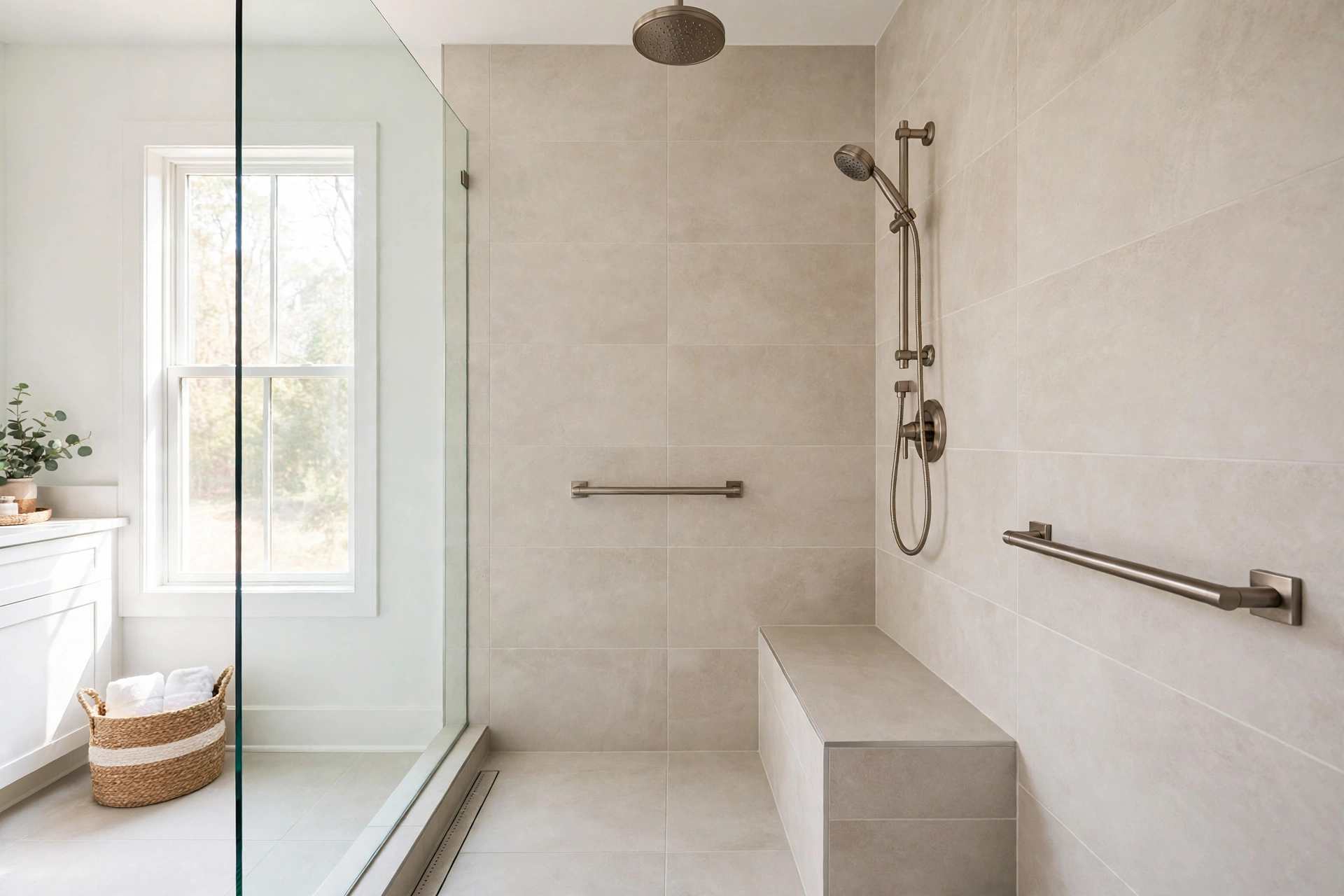
A low-entry shower with a bench, anchored grab bars and controls within reach helps a Dayton home stay workable as needs change. Blocking for the bars goes into real structure behind the wall, not just the surface.
Some Dayton households still want a real tub — for young children, for a long soak, or for a second bath in a busy family home. A deeper modern tub usually fits within two days, with fresh plumbing and a sealed surround.
A shower-only Dayton home can get a tub back without moving walls. A tub-shower combination returns, with renewed plumbing underneath and waterproofing behind the walls, built to stand up to daily family use.
Whole-room reworks suit Dayton baths where tub and shower both need attention at once, or where a dated 1980s bath needs a fresh start. One project, one written quote, with the wet area rebuilt first.
A tub-to-shower conversion turns the unused tub in a Dayton bath into a low-entry shower — pan, valve and drain renewed together.
Dayton sits in the Howard County contractor market, with crews working the corridors between Clarksville, Columbia, Ellicott City and Glenelg.
Most jobs land in the middle of these ranges, and the spread comes from the house, not the ZIP. A straightforward alcove swap is an easier job than a larger-lot home whose tile, glass and plumbing all need work at once.
The upper half of a range is priced in the written quote before work begins. For the method behind every figure, see the 2026 bathroom remodeling cost guide.
| Project | Planning range |
|---|---|
| Tub-to-shower conversion | $8,500 – $17,000 |
| Shower replacement | $7,500 – $15,000 |
| Walk-in shower | $9,000 – $18,000 |
| Bathtub replacement | $6,500 – $13,000 |
| Shower-to-tub conversion | $7,500 – $14,000 |
| Full bathroom remodel | $15,000 – $35,000+ |
Planning ranges based on published national installer pricing (2026), for budgeting guidance — not quotes. Compare quotes on what they cover: pan, valve and drain together.
The cheapest number often leaves a worn drain or tired valve behind new walls. Full methodology: the 2026 cost guide.
Dayton grew as a Howard County crossroads, and its bathrooms show that mix: older farmhouses, 1980s-built family homes and newer subdivisions on generous lots between Clarksville and Glenelg.
There are about 2,569 people in the Dayton service area, with Clarksville, Glenelg, Columbia, Fulton and Ellicott City at its edges.
Dayton homes are mostly larger single-family houses, many built in the 1980s. Their main baths are often spacious, but original tubs, valves and tile are now ageing out together.
Older farmhouses bring smaller, characterful baths, while newer subdivisions bring familiar family layouts. Either way, the room is measured first and the drain route is confirmed.
Most Dayton homes use public water and sewer, but larger lots on the community's rural edges can still run on a well and septic. The visit confirms the supply, pressure and drain layout before anything is chosen.
A tired valve can hide behind steady-looking pressure, so valves are checked before new walls go up. Well-water homes get the same attention, since mineral content can age fixtures faster.
Dayton winters bring cold snaps that test pipes, shut-offs and grout. Shut-offs and drainage are confirmed before winter, so a cold snap never becomes a leak behind new tile.
Summers are warm and humid on the Piedmont, making ventilation and fan airflow worth checking early. Fans, filters and seals get checked before the humid months settle in, and fall is a good window for booking before winter demand.
An illustrative wet-area remodel of the kind served around Dayton — shown as a design example, not a completed project photo in Dayton.
Nothing fancy — just a few things that help the specialist price your Dayton bath on the first visit. Know the home type: farmhouse, 1980s-built home, newer subdivision house or another build.
Note any history of slow drains, temperature swings or older plumbing quirks. Bring a rough footprint measurement and note whether a second bath exists, so the household keeps a wash-up option during the work.
Settle which outcome matters most first — a tub kept for children, a low-entry shower for older residents, or a full-room rework — so the quote prices the right job.
Our Dayton coverage centers on the town and ZIP 21036, with specialists travelling toward nearby Howard County towns — typical directions:
Coverage centers on Dayton and ZIP 21036 in Howard County, with specialists travelling the routes to Clarksville, Glenelg, Columbia, Fulton, and Ellicott City.
We publish planning ranges on every page. No “call for price”, no games — you budget before anyone visits.
The price you sign is the price you pay. Quotes are written, itemised and valid beyond the day of the visit — take your time deciding.
Installers are independent local contractors checked for licensing, insurance and wet-area specialisation before they take a single Being Sauna job — including experience with Howard County plumbing, 1980s-built homes and larger-lot water setups.
The biggest complaint in this industry is the same-day pressure close. Our specialists are instructed the opposite way: measure, explain, quote in writing, and leave the decision to you.
Call (833) 334-4470 or send the assessment form. Tell us the neighborhood, the bath, and whether the home is a farmhouse, 1980s-built home, newer subdivision house or another build — that is all the booking needs.
A vetted local specialist measures the room, checks the valves, drain, ventilation and water setup, and explains the options in plain language. No charge, no obligation.
Most wet-area projects finish in one to three days, with the house left clean and the new shower or tub demonstrated before the crew leaves.
Dayton wet-area projects follow the planning ranges on this page: tub-to-shower conversions $8,500-$17,000, shower replacements $7,500-$15,000, walk-in showers $9,000-$18,000, bathtub replacements $6,500-$13,000, shower-to-tub conversions $7,500-$14,000 and full remodels $15,000-$35,000+. Your exact price is confirmed in writing after a free in-home assessment.
Expect a larger single-family home, often on a generous lot, with a main bath that has served the same family for years. Many Dayton baths date from the 1980s building wave, so original tubs, valves and tile are common. The assessment measures the room, checks the drain route and plans around the home's existing plumbing.
Most Dayton homes use public water and sewer, but larger rural lots on the edges of the community can still run on a well and septic. The visit confirms the supply, pressure and drain layout before anything is chosen, so a tired valve or slow drain is found before new walls go up.
With a little planning, very little. Cold snaps test pipes and shut-offs, so those are confirmed before work starts. Humid summers make fan airflow and seals worth checking early. Most wet-area projects still finish in one to three days.
A vetted local specialist measures the room, checks the pan, valve, drain, ventilation and water setup, and walks through the options in plain language. You receive a written, itemised quote that stays valid beyond the day of the visit. There is no charge, no obligation, and no pressure to sign on the day.
How Being Sauna works (transparency note): Being Sauna is a free homeowner service that connects you with independent, vetted local bathroom remodeling contractors — we do not install bathrooms ourselves.
Cost figures are planning ranges from published national installer pricing; see our cost guide methodology. This page was last reviewed in October 2026. Questions: beingsauna@gmail.com or (833) 334-4470. Hours: Mon–Sat 9 AM–8 PM CT.
Free in-home assessment in Dayton · No pressure · No obligation
Call (833) 334-4470